Bridging CARLA to the CAN bus
Giving a virtual car real physics: a pure-I/O bridge between the CARLA driving simulator and vehicle bus signals — design, verification against ground truth, and the bugs.
The missing piece: physics
A virtual car gives you containerized ECUs talking over real signal databases, and even a real Android Automotive screen. What it doesn’t have is a world: an adaptive-cruise-control ECU is meaningless without a road, a lead vehicle, and physics that push back.
CARLA provides that world — an open-source, Unreal-based driving simulator with vehicle dynamics, traffic, pedestrians, and sensors. The job: connect CARLA to the vehicle buses so that an ECU publishing AccelDemand on CAN actually accelerates a simulated car, and the car’s speed comes back as a CAN frame the rest of the stack can consume.
This post covers a bridge design that solves this cleanly — three decisions you can reuse for any simulator-to-bus integration — and, maybe more useful, how to verify such a bridge isn’t lying to you.
Design: a dumb pipe with a smart hook
The bridge’s contract is deliberately tiny: flat key-value signals in, flat key-value signals out.
Fifty times a second it: reads incoming commands off the transport, applies each to CARLA (ego.throttle → that car’s throttle, world.weather.fog_density → the weather), reads back the observations you declared (speeds, positions, inter-vehicle gaps, sensor values), and publishes them.
Three decisions did the heavy lifting:
The engine is pure I/O; driving logic is a plug-in. The bridge itself never decides anything — it applies what arrives and reports what you configured. Anything smart (route following, ACC behavior, scenario timelines) lives in an optional control.py hook next to the config, with a three-method interface: setup() once after spawn, step() every tick to inject or override commands, observe() to add custom signals. Generic engine, per-project brains, no forks of the engine anywhere.
Configuration is a declarative YAML. Which cars to spawn (and where), which signal maps to which CARLA channel, which relations to publish — one file:
transport:
  type: remotive               # bus signals ↔ bridge channels
  inputs:
    - { frame: ACCControl, signal: AccelDemand, state: hero.accel_cmd }
  outputs:
    - { from: hero.speed_kmh, frame: ACCVehicleInfo,      signal: EgoSpeedKmh }
    - { from: gap,            frame: ACCEnvironmentModel, signal: FrontObjDistance }
actors:
  - { role: hero, blueprint: vehicle.tesla.model3, spawn: { policy: explicit, x: 446.0, y: -21.1 } }
  - { role: lead, blueprint: vehicle.audi.tt,      spawn: { policy: ahead_of, ref: hero, distance_m: 30 } }
pairs:
  - { name: gap, actor: hero, ref: lead, obs: distance_to }   # published as "gap"
One bridge, many tenants. CARLA is heavy; running one instance per project would be miserable. So the bridge is a singleton that watches a directory of case folders: drop a config in and it hot-loads, edit and it reloads, delete and its cars despawn — no restart, so attaching a new project never drops CARLA for the ones already running. The corollary rule: shared process, shared world — the map belongs to whoever attaches first.
Here’s what the closed loop looks like live — CARLA rendering the world while a HUD overlays the bus signals flowing through the bridge (ego speed in, ACC state and acceleration demand out):
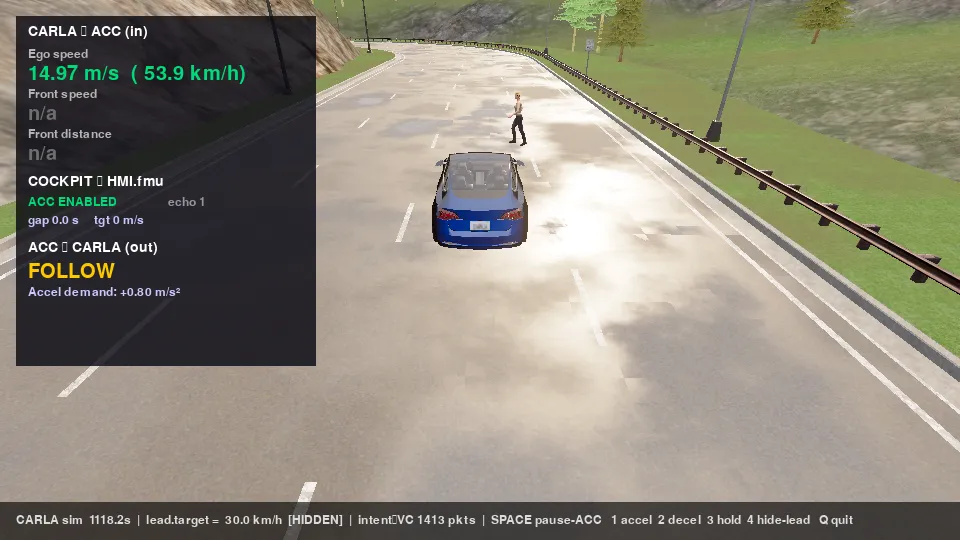 The bridge at work: the left panel is bus traffic (in and out), the scene is CARLA’s ground truth. When these two disagree, the bridge is lying.
Verify against ground truth, not vibes
A bridge can look right (car moves, numbers change) while quietly scaling something wrong. The only test that settles it: record the signals off the bus and, at the same moment, read CARLA directly — then compare.
| signal on the bus | bridge said | CARLA truth |
|---|---|---|
EgoSpeedKmh | 30.00 | 30.1 km/h |
FrontObjDistance | 17.90 | 17.86 m |
FrontObjSpeedMps | 8.36 | 8.33 m/s |
All mapped signals within 1 %. Then the end-to-end proof, which I like because it validates the loop rather than any single wire: put a compiled controller (an FMU — see the ACC post) in charge of the gap, note that its design parameter sets the minimum following distance, then swap the binary for one with a different parameter and watch what the simulated car does:
| FMU design gap | gap the car actually holds in CARLA |
|---|---|
| 11.5 m | 17.9 m |
| 25.0 m | 25.2 m |
The held gap tracks the parameter inside the controller binary. That only comes out right if bus → bridge → CARLA → bridge → bus all work — commands and observations, both directions, with correct units.
The resilience cases got the same treatment: kill CARLA mid-run (back in 18 s via restart: unless-stopped — a hard kill aborts the whole process because libcarla throws its timeout on a C++ thread Python can’t catch); restart the signal broker (bridge logs “stream dropped — resubscribing”, traffic resumes); 15-minute soak at a steady ~25 Hz with flat memory.
The bugs worth remembering
A silent 3.6× unit error. The ACC held a bizarre ~90 m gap and the car kept running away. Cause: feeding the controller km/h where it expected m/s. Units aren’t in the type system of a CAN signal — the .dbc says “16-bit unsigned, scale 0.01” and nothing else. Every boundary crossing needs an explicit unit check, because nothing else will do it for you.
Change-based delivery freezes steady streams. The signal broker delivers on change. Subscribe with on_change=True and the stream halts the moment a controller’s output goes steady — which looks exactly like a dead bridge. Bursts-then-silence is the signature; subscribing with on_change=False is the fix.
Steer along the road, not the car’s nose. For velocity-railed driving, we initially aligned the velocity vector with the car’s heading. First curve: straight off the road, since heading error compounds — the vector must follow the route tangent (the road’s direction at your position), which physically cannot leave the road. A one-line change and the single biggest quality jump in the whole scenario system.
std::bad_alloc means version mismatch. CARLA’s Python wheel must byte-match the server build. The failure mode is not a version warning but an allocation error deep in libcarla on connect. Pin the wheel next to the server version and never think about it again.
The clamp that ate the acceleration. The car accelerated far below its commanded demand — only on a loaded machine. A defensive dt = min(0.2, elapsed) clamp in the integration was discarding real elapsed time on slow ticks. Defensive clamps on time are lies you tell your integrator; they surface as physics that’s wrong only under load, which is the worst kind of intermittent.
The shape of the thing
What I’d reuse from this design anywhere a simulator meets a signal bus:
- Pure-I/O engine + declarative mapping + optional logic hook. The engine never grows project features; projects never fork the engine.
- A watched-directory singleton for expensive shared resources — hot attach/detach beats restart coordination across teams.
- Verification = same quantity, two paths. Bus signal vs. direct simulator read, plus one closed-loop test whose outcome depends on the whole chain being right.
- Unit checks at every boundary, because the wire format won’t carry them for you.